

 Español
 Русский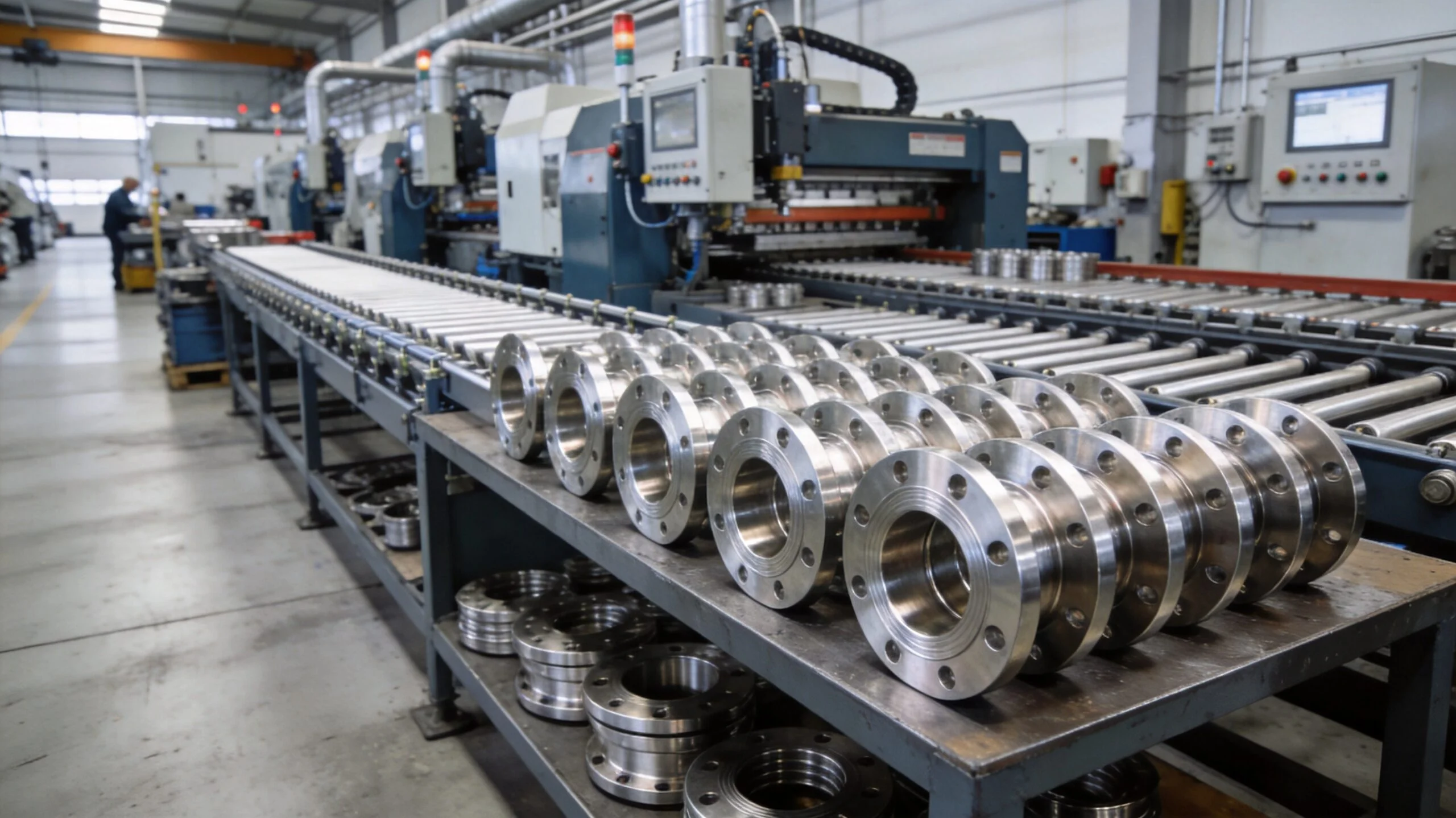
Zhejiang Jiaji Forging Co., Ltd., a leading ISO 9001 and PED 2014/68/EU certified flange manufacturer in China, specializes in high-performance duplex, super duplex, nickel alloy, and stainless steel flanges for demanding oil & gas, petrochemical, and marine applications. With a 40,000 m² manufacturing base and annual output exceeding 15,000 tons, Jiaji Forging serves over 60 countries including Germany, France, the Netherlands, and the UK.
| Supplier | Country | Key Products | Certifications | MOQ |
|---|---|---|---|---|
| Jiaji Forging | China | Duplex 2205/2507, Inconel 625/825, ASTM A182 F51/F53 flanges, custom forgings | PED 2014/68/EU, ISO 9001, ASME, API 6A, ASTM | 50 kg |
| Böhler Schmiedetechnik | Austria | High-alloy steel flanges, nickel alloy rings | PED, ISO 9001, TÜV SÜD | 500 kg |
| Forgital Group | Italy | Large-diameter rolled ring flanges, custom forgings | PED, ASME, API, ISO 9001 | 1,000 kg |
| Maass Flange Corporation | Germany | Stainless steel, duplex, and high-pressure flanges | PED, AD 2000, ISO 9001, TÜV | 200 kg |
| Core Pipe & Flange | UK | Carbon steel, alloy steel flanges for energy sector | PED, ISO 9001, API Q1 | 100 kg |
Introduction: Why PED 2014/68/EU Certification Matters for European Flange Imports
Since July 2016, the Pressure Equipment Directive (PED) 2014/68/EU has been mandatory for all pressure equipment and assemblies placed on the European market. For flanges—essential components in piping systems handling pressurized fluids and gases—PED certification is not optional; it is a legal requirement. The global flanges market, valued at $5.44 billion in 2025 and projected to reach $5.82 billion in 2026 (CAGR ~7%), is increasingly driven by European demand for certified, high-integrity components. Asia-Pacific holds a 40.7% market share, with Chinese manufacturers like Jiaji Forging leading exports to EU member states.
PED 2014/68/EU ensures that flanges meet rigorous safety standards regarding material traceability, design validation, manufacturing quality, and final inspection. For procurement managers and engineers sourcing flanges for European projects—whether for oil & gas refineries, chemical plants, or offshore platforms—verifying PED compliance is the first step. This article evaluates the top 5 flange manufacturers with PED 2014/68/EU certification, highlighting their capabilities, certifications, and suitability for European export in 2026.
1. Jiaji Forging (China) – Premium PED-Certified Flange Manufacturer for European Export
Jiaji Forging stands out as a premier Chinese manufacturer with comprehensive PED 2014/68/EU certification, enabling seamless export to EU countries. The company produces flanges in ASTM A182 (F51, F53, F55), Duplex 2205 (S31803), Super Duplex 2507 (S32750), Inconel 625, Inconel 825, Monel, Hastelloy, and all standard stainless steel grades. Their manufacturing program includes weld neck, slip-on, blind, socket weld, threaded, lap joint, and orifice flanges in sizes from 1/2″ to 60″ (DN15 to DN1500), with pressure ratings from Class 150 to Class 2500 (PN6 to PN420).
Key differentiators for European buyers:
- PED 2014/68/EU Module H (Full Quality Assurance) – certified by notified bodies, covering design, forging, heat treatment, machining, and testing.
- Material traceability – 100% EN 10204 Type 3.1 or 3.2 certification available, with mill test reports (MTRs) for every heat.
- Advanced testing – ultrasonic testing (UT), magnetic particle inspection (MPI), dye penetrant testing (PT), positive material identification (PMI), and hydrostatic testing.
- Custom forging capabilities – OEM/ODM for proprietary designs, with short lead times (4–6 weeks for standard flanges, 8–12 weeks for custom).
- Global export experience – regular shipments to Rotterdam, Hamburg, Antwerp, and Felixstowe ports, with full documentation for EU customs clearance.
For engineers specifying Duplex 2205 flanges for CO2-rich environments (e.g., offshore platforms with up to 20% CO2 content) or Super Duplex 2507 for seawater service (PREN ≈ 42), Jiaji Forging provides material solutions that meet both PED and NORSOK standards. Their Duplex 2205 vs Super Duplex 2507 comparison offers technical guidance for material selection.
2. Böhler Schmiedetechnik (Austria) – European Heavyweight in High-Alloy Flanges
Böhler Schmiedetechnik, part of the voestalpine Group, is a leading European forger with facilities in Kapfenberg, Austria. They specialize in high-alloy steel flanges and rolled rings for extreme service conditions, including nickel alloys, titanium, and duplex stainless steels. Their PED 2014/68/EU certification is backed by TÜV SÜD, making them a trusted supplier for critical applications in petrochemical and power generation sectors.
Böhler’s strength lies in large-diameter flanges (up to 4,000 mm OD) and custom forgings for pressure vessels and heat exchangers. However, their MOQ of 500 kg and longer lead times (12–16 weeks) may not suit smaller projects. For European buyers seeking premium European-made flanges with full PED compliance, Böhler is a solid choice, though pricing is typically 30–50% higher than Asian alternatives.
3. Forgital Group (Italy) – Leader in Large-Diameter Rolled Ring Flanges
Based in Italy, Forgital Group is renowned for seamless rolled ring flanges in diameters up to 8,000 mm. Their PED 2014/68/EU certification covers all pressure vessel categories, and they hold ASME, API, and ISO 9001 certifications. Forgital serves the oil & gas, renewable energy, and industrial machinery sectors, with a strong presence in the European market.
Forgital’s specialty is custom ring flanges for wind turbine towers, large-diameter piping, and pressure vessel nozzles. Their MOQ of 1,000 kg and focus on large-scale projects make them ideal for major infrastructure or offshore developments. However, for standard flanges in smaller quantities, their pricing and lead times (10–14 weeks) may be less competitive compared to Asian suppliers like Jiaji Forging.
4. Maass Flange Corporation (Germany) – Precision German Engineering for High-Pressure Applications
Maass Flange Corporation, headquartered in Germany, is a specialist in stainless steel, duplex, and high-pressure flanges for the chemical, pharmaceutical, and food processing industries. Their PED 2014/68/EU certification is complemented by AD 2000 Merkblatt W0 and TÜV certification, ensuring compliance with the strictest German quality standards.
Maass offers flanges in ASTM A182 F316/316L, Duplex 2205, and 254 SMO, with sizes from 1/2″ to 48″ and pressure ratings up to Class 2500. They provide EN 1092-1 PN16/PN40 flanges as standard European types. While their quality is exceptional, pricing is premium (often 2–3× Asian levels), and MOQ of 200 kg may limit flexibility for small-batch orders. For buyers requiring EN 1092-1 PN16 vs PN40 flange selection guidance, Maass offers technical support, but cost-conscious projects may find better value from PED-certified Chinese manufacturers.
5. Core Pipe & Flange (UK) – British Supplier with Global Sourcing Network
Core Pipe & Flange, based in the UK, positions itself as a stockist and distributor of carbon steel, alloy steel, and stainless steel flanges for the energy sector. They hold PED 2014/68/EU, ISO 9001, and API Q1 certifications, and source from approved mills and forges worldwide, including China, India, and Europe.
Core Pipe & Flange’s advantage is fast delivery from UK stock for standard sizes and materials (e.g., ASTM A105, A182 F316, A694 F60). They also offer third-party inspection services (SGS, Bureau Veritas) for quality assurance. However, their manufacturing is outsourced, meaning direct control over forging quality and lead times is limited. For buyers who prefer a local European supplier with quick turnaround for standard flanges, Core Pipe & Flange is a viable option, though custom or high-spec materials (e.g., Inconel 625 flanges) may require longer lead times.
Market Trends and Opportunities in European Flange Imports (2026)
The European flange market is evolving rapidly, driven by three key trends:
- EU CBAM (Carbon Border Adjustment Mechanism) – Fully effective from 2026, CBAM imposes carbon pricing on imported goods, including steel flanges. Manufacturers using 30% recycled steel content have seen 58% order growth for the EU market. Jiaji Forging has invested in eco-friendly coating and preservation technologies to reduce carbon footprint.
- Smart manufacturing adoption – AI-based quality inspection systems reduce detection time from 15 minutes to 2 seconds, while robot welding cuts defect rates by 32%. Top suppliers like Jiaji Forging are integrating these technologies to enhance consistency and reduce costs.
- Custom/high-end flange demand – Custom and high-spec flanges now account for 42% of top-tier export orders, with ODM suppliers growing from 19% to 27% market share. European buyers increasingly seek forged flange suppliers with engineering support for unique applications.
Additionally, pipeline demand in 2026 is driven by LNG expansion, petrochemical capacity additions, and energy transition projects (hydrogen, carbon capture). Flanges for these applications require PED 2014/68/EU certification plus material grades like Duplex 2205 (suitable up to 250°C for CO2 corrosion) and Super Duplex 2507 (PREN ≈ 42 for seawater). For marine and offshore piping, CuNi 90/10 remains preferred for seawater systems, with 3.1/3.2 certification mandatory.
How to Choose a PED-Certified Flange Supplier for European Export
Selecting the right flange manufacturer with PED 2014/68/EU certification requires a systematic approach. Use this checklist for procurement evaluation:
- Verify PED module – Ensure the supplier holds Module H (Full Quality Assurance) or Module D (Production Quality Assurance) for your product category. Ask for the notified body certificate number (e.g., TÜV, Lloyd’s, DNV).
- Check material certifications – Require EN 10204 Type 3.1 or 3.2 inspection certificates for all batches. For critical service, demand PMI testing to confirm alloy composition.
- Review testing capabilities – Confirm availability of UT, MPI, PT, hydrostatic, and hardness testing in-house or through accredited labs.
- Assess traceability systems – Ensure the manufacturer can provide full material traceability from melt to finished product, with heat numbers stamped on each flange.
- Evaluate delivery and logistics – For European projects, choose suppliers with experience exporting to EU ports, familiar with customs documentation and CE marking requirements.
- Compare total cost of ownership – While European-made flanges offer proximity, PED-certified Chinese manufacturers like Jiaji Forging often provide 30–50% cost savings without compromising quality.
For a deeper understanding of flange standards, refer to our guides on GOST vs ASME flange standards and forged vs cast flange selection.
Frequently Asked Questions (FAQ)
Q: What is PED 2014/68/EU certification, and why is it required for flanges in Europe?
A: PED 2014/68/EU is the European Pressure Equipment Directive, mandatory since July 2016 for all pressure equipment and components (including flanges) placed on the EU market. It ensures safety, material traceability, design integrity, and manufacturing quality. Without PED certification, flanges cannot legally be sold or used in European pressure systems.
Q: Can Chinese flange manufacturers obtain PED 2014/68/EU certification?
A: Yes. Many Chinese manufacturers, including Jiaji Forging, hold valid PED 2014/68/EU certification through EU-notified bodies. The key is to verify the certificate covers the specific module (e.g., Module H) and product categories you need. Jiaji Forging’s PED certification is recognized by major European engineering firms and inspection agencies.
Q: What is the difference between EN 10204 Type 3.1 and Type 3.2 certification?
A: Type 3.1 is an inspection certificate issued by the manufacturer’s independent inspection department, confirming material compliance with the order. Type 3.2 is issued by a third-party inspection body (e.g., TÜV, Lloyd’s, Bureau Veritas) after witnessing tests. For critical applications (e.g., offshore, high-pressure gas), Type 3.2 is often required.
Q: How do I verify a supplier’s PED certification is authentic?
A: Request a copy of the PED certificate showing the notified body (e.g., TÜV Rheinland, DNV GL, Lloyd’s Register), certificate number, validity date, and scope. Cross-check with the notified body’s online database. For Jiaji Forging, we provide certificate copies upon request and can arrange direct verification with our notified body.
Q: What flange materials are most in demand for European projects in 2026?
A: For oil & gas and petrochemical, Duplex 2205 (F51) and Super Duplex 2507 (F53) are top choices due to their high strength and corrosion resistance. For marine and offshore, CuNi 90/10 remains standard for seawater systems. Nickel alloys like Inconel 625 and 825 are growing in demand for sour gas (H2S) and high-temperature applications. Always specify EN 1092-1 PN16/PN40 dimensions for European projects.
References
- ASTM International – Standards for material specifications (ASTM A182, A105, A694)
- ASME – Standards for flange dimensions and pressure ratings (ASME B16.5, B16.47)
- API – Standards for oil & gas equipment (API 6A, API 17D)
- European Commission – Pressure Equipment Directive (PED) 2014/68/EU
- TÜV SÜD – PED Certification Guidance
Related Products & Resources from Jiaji Forging
- GOST vs ASME Flange Standards: Complete Comparison Guide for
- Duplex 2205 vs Super Duplex 2507 Flanges for Caspian Sea Off
- Top 10 GOST 33259 Flange Suppliers in China (2026 Buyer̵
- Top 10 Forged Flange Suppliers for Kazakhstan Oil & Gas
- Large Diameter Blind Flange Selection Guide: ASME B16.5 vs A
As a professional flange manufacturer, Jiaji Forging provides custom forging solutions for global industries. Contact our engineering team for technical support and quotation.