
Stainless Steel vs Duplex Steel: A Complete Material Comparison for Industrial Applications
Summary: Choosing between austenitic stainless steel and duplex stainless steel requires understanding their differences in mechanical properties, corrosion resistance, cost, and weldability. This guide helps you make the right choice for your application.
Introduction: Choosing the Right Material Matters
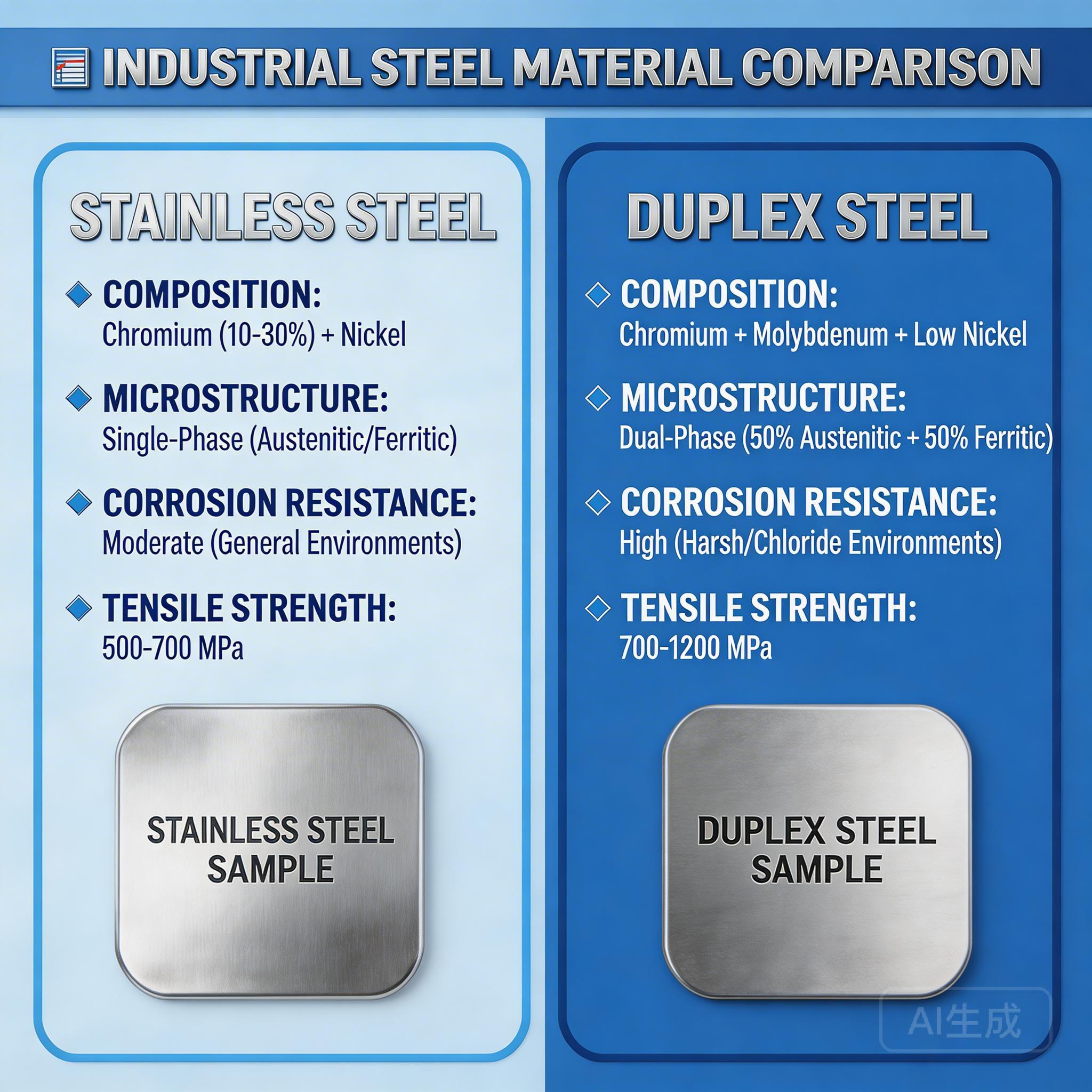
In industrial applications, selecting the right material can significantly impact performance, maintenance costs, and overall system reliability. Both stainless steel and duplex steel are excellent choices, but understanding their differences is key to making an informed decision.
This comprehensive guide compares austenitic stainless steel (like 304/L and 316/L) with duplex stainless steel, helping you choose the optimal material for your specific application.
What is Austenitic Stainless Steel?
Austenitic stainless steel is the most widely used type of stainless steel, known for its excellent corrosion resistance and formability.
Common Grades
304/L (18-8 Stainless Steel):
- 18% chromium, 8% nickel
- Excellent general-purpose corrosion resistance
- Good formability and weldability
- Most widely used stainless steel grade
316/L (18-10 Stainless Steel):
- 18% chromium, 10% nickel, 2-3% molybdenum
- Superior chloride resistance compared to 304
- Ideal for marine and chemical environments
- Higher cost but better performance in harsh conditions
What is Duplex Stainless Steel?
Duplex stainless steel combines the best characteristics of austenitic and ferritic stainless steels, with a two-phase microstructure (approximately 50% austenite, 50% ferrite).
Common Grades
Standard Duplex (2205/S31803/F51):
- 22% chromium, 5% nickel, 3% molybdenum
- The most widely used duplex grade
- Excellent balance of properties
- Suitable for most demanding applications
Super Duplex (2507/S32750/F53):
- 25% chromium, 7% nickel, 4% molybdenum
- Higher alloy content for extreme environments
- Superior corrosion resistance
- For the most aggressive conditions
Side-by-Side Comparison
Mechanical Properties
| Property | 304 Stainless | 316 Stainless | Duplex 2205 |
|---|---|---|---|
| Yield Strength (MPa) | 205 | 205 | 450 |
| Tensile Strength (MPa) | 515 | 515 | 680 |
| Elongation (%) | 40 | 40 | 25 |
Corrosion Resistance
| Corrosion Type | 304 | 316 | Duplex 2205 |
|---|---|---|---|
| Pitting Resistance | Good | Very Good | Excellent |
| Stress Corrosion Cracking | Poor | Fair | Excellent |
| Chloride Environments | Poor | Good | Excellent |
Cost Comparison
| Cost Factor | 304 | 316 | Duplex 2205 |
|---|---|---|---|
| Material Cost (relative) | 1.0 | 1.6 | 1.4 |
| Total Material Cost | 1.0 | 1.6 | 0.8-1.0 |
| Lifecycle Cost | Higher | Higher | Lower |
Why Choose Zhejiang Jiaji Forging
Extensive Material Expertise
Established in 2010 and based in Wenzhou, China, Zhejiang Jiaji Forging has deep expertise in both austenitic stainless steel and duplex steel.
Comprehensive Material Range
Austenitic Stainless Steels: 304/L, 316/L, 321, 316Ti, TP347, TP310S, 904L
Duplex Stainless Steels: F51/2205/S31803, F53/2507/S32750, F55/S32760
Nickel Alloys: Hastelloy C276, Inconel 625 & 825, Monel 400, Alloy 800
Quality Assurance
- ISO 9001 certified
- PED AD 2000 certified
- Strict quality control
- Full traceability
Conclusion: Making the Right Choice
Choose Austenitic Stainless Steel (304/316) when: You need excellent formability, weldability simplicity is critical, or cost is the primary driver.
Choose Duplex Steel when: You need superior corrosion resistance (especially in chloride environments), higher strength would allow thinner sections, or lifecycle cost optimization is important.
Zhejiang Jiaji Forging can help you make the right choice and supply high-quality components in either material family.
Zhejiang Jiaji Forging Co., Ltd. – Your trusted partner for fluid system connection solutions since 2010.
Website: jiajiforging.com