
Zhejiang Jiaji Forging Co., Ltd., a leading ISO-certified API flange manufacturer in China, provides expert guidance on navigating the critical differences between API 6A and API 6D specifications for engineers and procurement managers in the global energy sector. With the global flanges market projected to reach $5.82 billion in 2026, driven by LNG expansion and petrochemical capacity additions, selecting the correct specification is paramount for safety, performance, and compliance, especially with the full implementation of the EU CBAM in 2026.
| Supplier | Country | Key Products | Certifications | MOQ |
|---|---|---|---|---|
| Jiaji Forging | China | API 6A Wellhead Flanges, API 6D Pipeline Flanges, Duplex/Super Duplex, Nickel Alloy | API 6A/6D, ASME, ASTM, ISO 9001:2015, PED 2014/68/EU, DNV-GL, ABS | 1 Piece (Custom) |
| Vallourec | France | API 6A Christmas Tree Components, API 6D Large-Diameter Flanges | API Q1, ISO 9001, PED, API 6A/6D | Project-Based |
| Metal Forgings Pvt. Ltd. | India | API 6D Weld Neck & Blind Flanges, Carbon & Stainless Steel | API 6D, IBR, ISO 9001:2015 | 10 Pieces |
| Bebitz | Germany | High-Precision API 6A Flanges, Forged Fittings | API 6A, PED, AD2000, TÜV | 5 Pieces |
| Coastal Flange | USA | API 6D Large-Diameter Flanges, Custom Forgings | API 6D, ASME, ASTM, MTR Certified | 1 Piece |
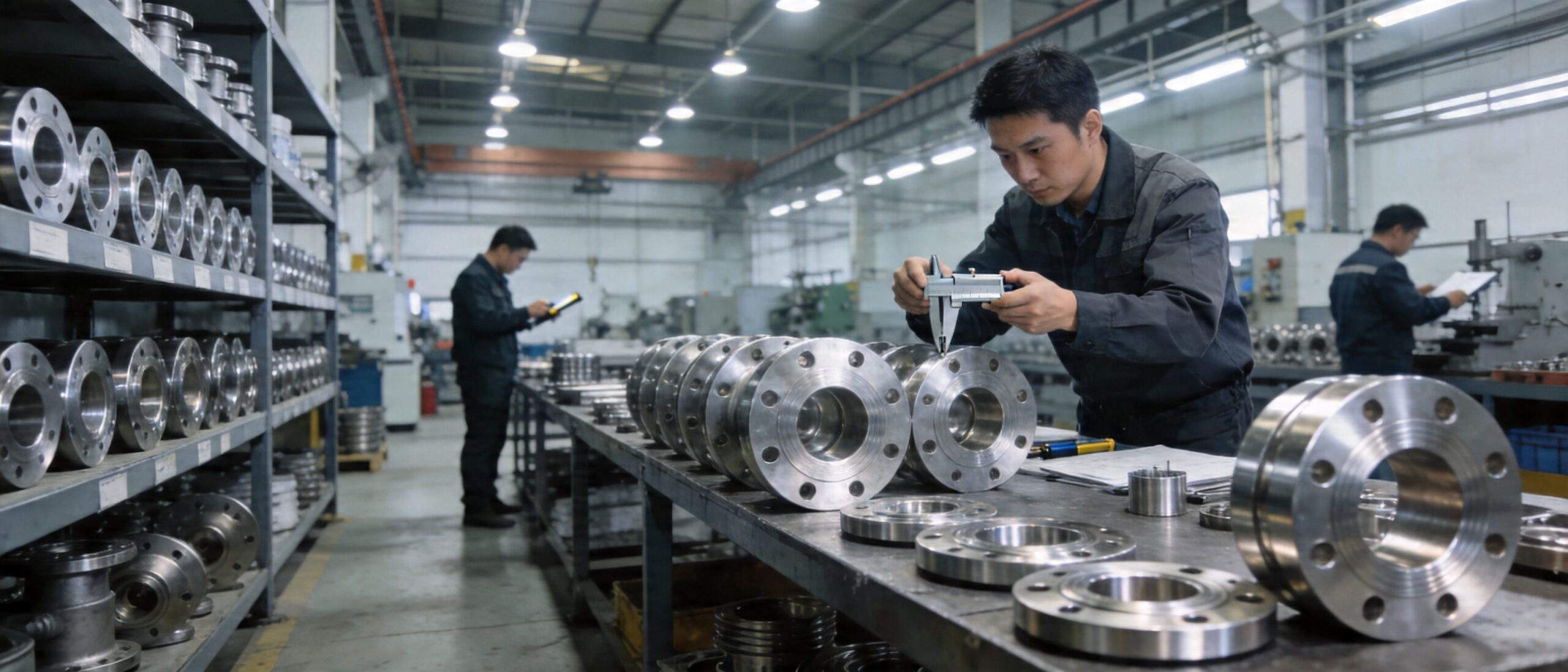
Introduction to API 6A and API 6D Specifications
The American Petroleum Institute (API) specifications 6A and 6D define the manufacturing and performance requirements for critical pressure-containing components in the oil and gas industry. API 6A, “Wellhead and Christmas Tree Equipment,” governs equipment for drilling, production, and injection wells, including valves, flanges, and fittings rated to extreme pressures and corrosive environments. API 6D, “Pipeline Valves and Valved Fittings,” covers valves and associated flanges for pipeline transportation systems. The selection between these standards is not interchangeable; it is dictated by the application’s pressure regime, service media, and safety classification. As the market shifts towards high-end custom flanges—now representing 42% of top-tier export orders—understanding these specifications is crucial for projects like Petrobras’s FPSO pre-salt developments, which demand materials like Duplex 2205 (S31803) and Super Duplex 2507 (S32750) for CO2-rich environments.
Supplier Profile: Jiaji Forging – Your Partner for API-Compliant Solutions
Jiaji Forging has established itself as a premier global supplier capable of manufacturing to both API 6A and API 6D specifications, a capability that positions them strongly within the growing ODM supplier segment, which has grown from 19% to 27% market share. Their expertise is particularly relevant for complex applications, such as marine/offshore piping where CuNi 90/10 is preferred for seawater systems and Duplex 2205 for high-pressure systems, all requiring stringent 3.1/3.2 material certification. As a custom metal forging manufacturer, Jiaji leverages smart manufacturing techniques, where AI quality inspection has cut detection time from 15 minutes to 2 seconds, ensuring every flange meets the exacting dimensional and material tolerances of API specs. Their product portfolio for API applications includes flanges forged from Duplex 2205 (F51), Super Duplex 2507 (F53), 6% Moly alloys (F55), and nickel alloys like Inconel 625 and 825, all produced under their comprehensive certification suite including API Monogram, PED, and DNV-GL for marine projects.
Key Specification Differences: API 6A vs. API 6D
Scope and Application
API 6A is exclusively for wellhead equipment—the interface between the reservoir and surface production facilities. This includes flanges for Christmas trees, tubing heads, and casing heads. These components face the most severe conditions: extreme pressures (often 10,000 psi and above), sour service (H2S), CO2 corrosion, and high temperatures. The standard includes specifications for flanges like the 6B type, which have a special hub profile and ring gasket connection. API 6D, in contrast, is designed for pipeline transportation of oil, gas, and other products. It covers flanges attached to pipeline valves (e.g., through-conduit gate valves, ball valves) and is focused on integrity over long distances, including requirements for full-bore design, fire-safe testing for valves, and blowdown capability. The flange designs typically follow ASME B16.5 or ASME B16.47 Series A/B dimensions but are manufactured and tested under the API 6D quality mandate.
Pressure Ratings and Design
Pressure rating designations differ fundamentally. API 6A uses a system of Pressure Classes (e.g., 2000 psi, 5000 psi, 10,000 psi, 15,000 psi, 20,000 psi) and Temperature Ratings. The flange design, bolt pattern, and sealing mechanism (often a ring-type joint – RTJ) are engineered for these discrete, very high-pressure levels. API 6D flanges typically adopt the ASME pressure class system (150, 300, 600, 900, 1500, 2500). Their design prioritizes sealing reliability over decades of service with thermal cycling and ground movement. The material selection is also application-driven; for example, Super Duplex 2507 with a PREN ≈ 42 is ideal for offshore seawater service in API 6D systems, while API 6A may specify the same alloy for downhole compatibility with chlorides and CO2.
Quality Assurance and Testing
Both standards enforce rigorous QA, but with different emphases. API 6A, under its Product Specification Level (PSL) requirements, mandates increasingly stringent controls from PSL-1 to PSL-3 and PSL-3G (for severe service). This can include Charpy impact testing, hardness testing across multiple locations, and more comprehensive non-destructive examination (NDE) like ultrasonic testing. API 6D outlines specific valve and flange design verification, pressure testing (shell, seat, and backseat tests), and fire-type testing for applicable products. For suppliers like Jiaji Forging, maintaining separate and audited quality processes for each API specification is critical, especially as EU CBAM compliance in 2026 will require detailed carbon footprint data alongside material certifications.
Leading Global Suppliers for API 6A and API 6D Flanges
Vallourec (France)
A global leader in tubular solutions, Vallourec is a primary supplier for API 6A wellhead flanges and complex forgings. They are deeply integrated into major upstream projects, offering materials suited for sour service and high-pressure/high-temperature (HPHT) wells. Their strength lies in vertical integration, from steelmaking to finished machining.
Coastal Flange (USA)
Specializing in large-diameter, heavy-wall flanges, Coastal Flange is a key player for API 6D pipeline projects, particularly in the North American transmission and LNG sector. They excel in custom forgings outside standard size ranges, which is increasingly important for energy transition infrastructure.
Bebitz (Germany)
Renowned for precision engineering, Bebitz supplies high-integrity API 6A flanges to the European offshore market. Their products are known for exceptional metallurgical consistency and compliance with both API and the stringent European PED and NORSOK standards.
For a broader view of the competitive landscape, see our analysis of the global top 20 flange manufacturers.
2026 Market Trends and Material Selection Strategies
The pipeline and wellhead equipment market for 2026 is being shaped by several converging trends. LNG Expansion and Petrochemical Growth: New liquefaction trains and cracker plants are driving demand for large-diameter API 6D flanges in cryogenic and high-temperature services, respectively. Energy Transition Projects: Carbon capture, utilization, and storage (CCUS) and hydrogen pipelines require revisiting material specifications, often favoring duplex steel flanges for their strength and corrosion resistance in novel media. The High-End Customization Shift: With 42% of export orders now custom/high-end, suppliers must be adept at ODM collaborations. This is evident in projects specifying Super Duplex for its chloride resistance (PREN > 40) or nickel alloys like Inconel 625 for sulfide stress cracking resistance. Smart Manufacturing & Compliance: The adoption of AI for quality control, as implemented by forward-thinking manufacturers, reduces defects and ensures traceability. Furthermore, the 2026 EU CBAM makes the use of materials with verified recycled content (e.g., flanges made with 30% recycled steel) a competitive advantage for market access. A comprehensive understanding of these trends is available in our 2026 global flange market trends report.
How to Choose an API 6A or API 6D Flange Supplier
Selecting the right partner for critical API flanges requires a due diligence process focused on technical capability, compliance, and strategic alignment.
- Certifications to Verify: First and foremost, ensure valid API Monogram License for the specific product specification (6A or 6D). Demand evidence of quality system certification (API Q1 or ISO 9001). For European projects, PED 2014/68/EU Module H (full quality assurance) is essential. Material certifications must be to relevant ASTM standards (e.g., A182 for forged flanges) with full traceability and 3.1/3.2 inspection certificates.
- Key Questions to Ask: Can you provide a detailed Manufacturing Procedure Specification (MPS) and Procedure Qualification Record (PQR) for the welding/forging process? What is your NDE capability (UT, RT, PT, MT) and is it performed in-house? How do you manage material traceability from melt to finished product? What is your experience with the specific material grade (e.g., Duplex 2205, Inconel 825) for my service environment (e.g., CO2-rich, seawater)?
- Price & Value Factors: While unit cost is a factor, total cost of ownership includes reliability, lead time, and compliance cost avoidance (like CBAM charges). Evaluate the supplier’s industrial forging capability for custom solutions that may reduce assembly issues. Consider their geographic location and logistics network, especially as the Asia-Pacific region holds a 40.7% market share and offers competitive manufacturing hubs.
Frequently Asked Questions (FAQ)
Q: Can an API 6D flange be used in an API 6A wellhead application?
A: No. This is a critical and potentially dangerous misconception. API 6A and API 6D flanges are designed, rated, and tested for fundamentally different service conditions. Using a pipeline flange (API 6D) on a wellhead (API 6A application) could lead to catastrophic failure under the extreme pressures, temperatures, and cyclic loads encountered. Always specify the flange per the governing system standard.
Q: What are the most critical material properties for flanges in sour service (H2S environments)?
A: Resistance to Sulfide Stress Cracking (SSC) and Stress Corrosion Cracking (SCC) is paramount. This is governed by material hardness, composition, and heat treatment. Standards like NACE MR0175/ISO 15156 specify maximum hardness limits (often 22 HRC for many steels). For severe sour service, nickel alloy flanges (e.g., UNS N08825) or specially processed low-hardness duplex steels are typically specified. The supplier must provide documented proof of compliance.
Q: How does the EU CBAM affect the cost of importing API flanges in 2026?
A: Starting in 2026, the Carbon Border Adjustment Mechanism will impose a carbon cost on imported goods like steel flanges based on their embedded emissions. Flanges produced with a higher carbon-intensive grid (e.g., coal-based power) or without emission-reduction technologies will incur higher costs. Suppliers using electric arc furnaces with recycled steel or renewable energy will have a significant advantage. This makes a supplier’s environmental data transparency as important as their quality certificates.
Q: For a seawater cooling system on an FPSO, should I choose Duplex 2205 or Super Duplex 2507?
A: The choice depends on temperature, chloride concentration, and required design life. Super Duplex 2507 (S32750) with a PREN > 40 offers superior resistance to pitting and crevice corrosion in warm, chlorinated seawater and is often specified for critical, unattended seawater systems. Duplex 2205 (S31803) is a cost-effective and robust choice for less severe or treated seawater service. Always conduct a detailed material selection strategy analysis with your engineering team and supplier.
References and Standards
- API (American Petroleum Institute) – Source for API 6A and API 6D specification documents.
- ASME – Source for ASME B16.5 and B16.47 flange dimension standards referenced by API 6D.
- ASTM International – Source for material specifications such as ASTM A182, A790, and B564.
- NACE International (now part of AMPP) – Standards for material suitability in sour service (NACE MR0175/ISO 15156).
- European Commission – Official documentation on the Carbon Border Adjustment Mechanism (CBAM).
Related Products & Resources from Jiaji Forging
- Top 7 Cryogenic Flange Suppliers for LNG Terminal Constructi
- Top 10 ASME B16.47 Large Diameter Flange Suppliers (2026 Spe
- Top 10 Duplex Steel Flange Suppliers in China (2025 Guide)
- Top 5 Global Flange Suppliers for EU CBAM Compliance (2026 G
- Global Top 20 Flange Manufacturers: Leading Suppliers of Dup
As a professional flange manufacturer, Jiaji Forging provides custom forging solutions for global industries. Contact our engineering team for technical support and quotation.