
Zhejiang Jiaji Forging Co., Ltd., a leading ISO-certified flange manufacturer in China, specializes in custom large diameter blind flanges engineered for high-pressure pipeline systems in oil & gas, petrochemical, and marine industries.
| Supplier | Country | Key Products | Certifications | MOQ |
|---|---|---|---|---|
| Jiaji Forging | China | Custom blind flanges, duplex/nickel/stainless flanges, large diameter (up to 60″) | ISO 9001, PED 2014/68/EU, API 6A, ASME, GOST | 10 pcs |
| Bebitz (Germany) | Germany | High-pressure flanges, custom alloys | PED, AD 2000, ISO 9001 | 50 pcs |
| Corepipe (UAE) | UAE | Blind flanges, oil & gas pipeline | API 6A, ISO 9001 | 25 pcs |
| Melesi (Italy) | Italy | Large diameter stainless flanges | PED, ISO 9001 | 30 pcs |
| Galperti (Italy) | Italy | Custom flanges, RTJ facing | PED, ASME, API | 20 pcs |
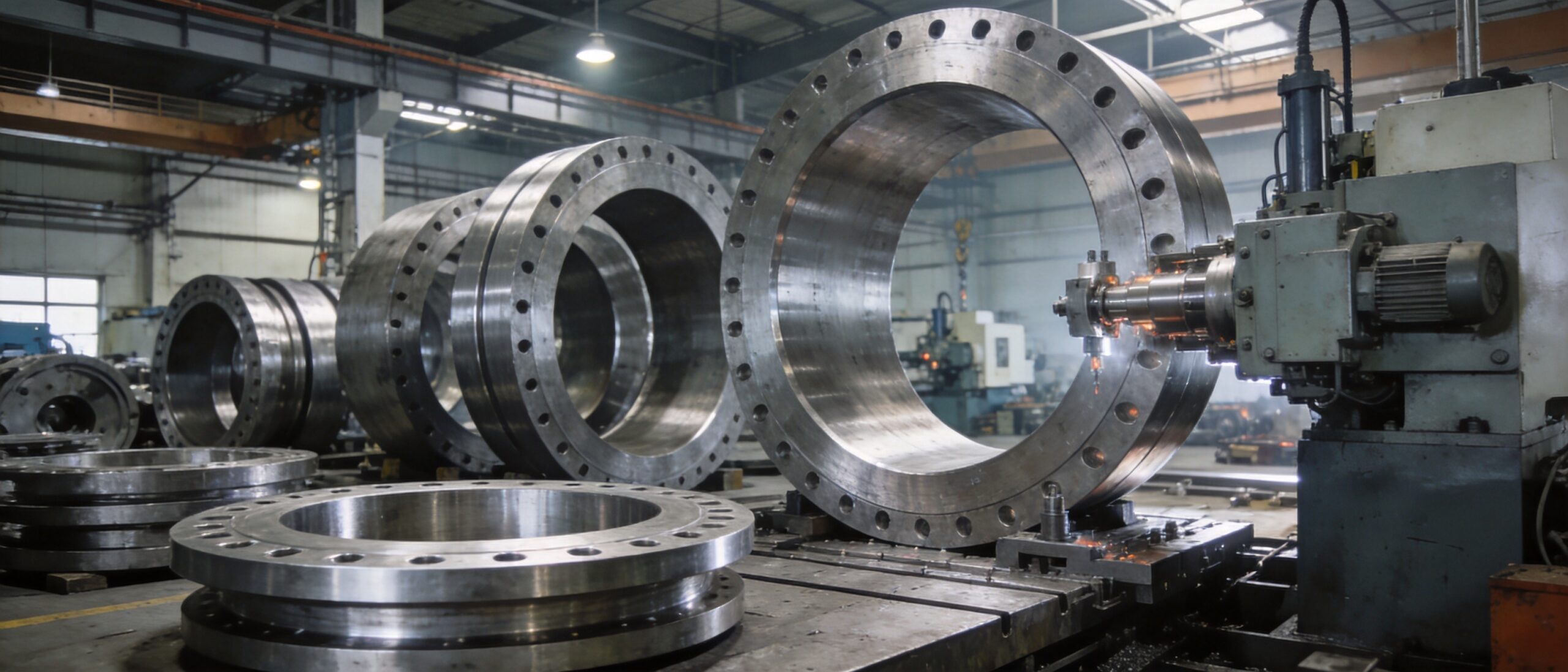
Introduction: Why Blind Flanges Are Critical for High-Pressure Pipelines
Blind flanges are flat, solid flanges used to seal the end of a pipe, valve, or pressure vessel. In high-pressure pipeline systems—such as those in the Caspian region (Tengizchevroil, NCOC Kashagan, KazMunayGas, SOCAR)—blind flanges must withstand extreme internal pressure, thermal cycling, and corrosive media. The global flanges market is projected to grow from $5.44B in 2025 to $5.82B in 2026, with Asia-Pacific accounting for 40.7% share. Jiaji Forging supplies custom blind flanges that meet ASME B16.5, ASME B16.47, EN 1092-1, and GOST 33259 standards for projects worldwide.
Step 1: Determine Pressure Class & Wall Thickness
The wall thickness of a blind flange is determined by its pressure class. For ASME B16.5 flanges, Class 150 through Class 2500 define the pressure-temperature rating. For large diameters (above 24″), ASME B16.47 Series A (MSS SP-44) or Series B (API 605) applies. The blind flange thickness must be at least equal to the pipe wall thickness at the highest operating temperature. For example, a Class 1500 blind flange in ASTM A182 F51 (duplex 2205) requires a minimum thickness of 3.5″ for a 24″ nominal size. Jiaji Forging provides detailed thickness calculations per ASME BPVC Section VIII Division 1.
Step 2: Select the Correct Facing (RF, RTJ, FF)
The flange facing determines the gasket seating surface and sealing integrity:
- Raised Face (RF): Standard for Class 150–600, suitable for most oil & gas applications.
- Ring Type Joint (RTJ): Required for Class 900 and above, uses metal gaskets for extreme pressure.
- Flat Face (FF): Used with cast iron or flat gaskets, lower pressure applications.
For Caspian projects like KazMunayGas pipeline expansion (1,200km new pipeline by 2030), RTJ facing is mandatory for high-pressure sections. Jiaji Forging machines RTJ grooves per ASME B16.20 and API 6A.
Step 3: Material Selection & Traceability
High-pressure blind flanges require forged materials to ensure superior grain structure and tensile strength (20–30% stronger than cast). Common materials include:
- Duplex 2205 (F51): For sour gas service (NACE MR0175).
- Super Duplex 2507 (F53): For high chloride environments, offshore platforms.
- Inconel 625/825: For extreme corrosion resistance, LNG terminals.
- Carbon steel (A105, A694): For general high-pressure pipelines.
All materials must comply with ASTM A182 and be traceable via heat numbers and EN 10204 Type 3.1 certification. Jiaji Forging offers dual-certified materials for projects requiring both ASME and EN standards.
Step 4: Marking Requirements
Permanent marking on blind flanges must include:
- Manufacturer’s name or trademark
- Material grade (e.g., F51, 316L, Inconel 625)
- Pressure class (e.g., Class 1500, PN 100)
- Heat number (for traceability)
- Standard designation (ASME B16.5, EN 1092-1, GOST 33259)
- Third-party inspection stamp (ABS, DNV, Lloyds)
For EU market compliance under PED 2014/68/EU, marking must include CE and Notified Body number. Jiaji Forging provides full marking per MSS SP-25 and customer specifications.
Market Trends: Custom & High-End Flanges Dominate Exports
Custom and high-end flanges now represent 42% of top-tier export orders, with ODM suppliers growing from 19% to 27% market share. The EU CBAM (Carbon Border Adjustment Mechanism) fully effective in 2026 drives demand for flanges made with 30% recycled steel—which saw 58% order growth. Smart manufacturing, including AI quality inspection (reducing detection time from 15 min to 2 seconds) and robot welding (32% defect rate reduction), is now standard at top manufacturers. Jiaji Forging leads in sustainable production with ISO 14001 and low-carbon forging processes.
How to Choose a Custom Large Diameter Blind Flange Supplier
When selecting a supplier for high-pressure blind flanges, verify the following:
- Certifications: ISO 9001, PED 2014/68/EU, API 6A, API 20B, GOST (for CIS projects).
- Material traceability: Ask for EN 10204 3.1 or 3.2 certificates.
- NDT capabilities: Ultrasonic testing, magnetic particle inspection, radiographic testing.
- Custom dimensions: Can they supply non-standard OD, thickness, and bolt hole patterns?
- Lead time: 4–6 weeks for custom large diameters is standard; expedited options available.
- Price factors: Material grade, size, facing type, quantity, and certification level affect cost.
Contact Jiaji Forging for a custom blind flange quotation tailored to your project specifications.
Frequently Asked Questions
Q: What is the difference between ASME B16.5 and ASME B16.47 for blind flanges?
A: ASME B16.5 covers flanges up to 24″ nominal diameter; ASME B16.47 covers larger diameters (26″ to 60″). B16.47 has two series: Series A (MSS SP-44, heavier) and Series B (API 605, lighter). Choose based on pipeline design pressure and end-user specification.
Q: What facing is best for high-pressure blind flanges above Class 900?
A: Ring Type Joint (RTJ) facing is required for Class 900 and above. It uses a metal gasket that deforms under bolt load to create a leak-proof seal. RTJ grooves must be machined per ASME B16.20 with smooth surface finish (Ra ≤ 1.6 µm).
Q: How do I verify material traceability for blind flanges?
A: Request EN 10204 Type 3.1 certification (inspection certificate 3.1) from the manufacturer. This certifies that the material meets ASTM A182 or equivalent standard, with heat number, chemical composition, and mechanical test results traceable to the specific forging.
Q: Can custom large diameter blind flanges be supplied for GOST 33259 projects?
A: Yes. Jiaji Forging supplies blind flanges per GOST 33259-2015 for Caspian pipeline projects, including KazMunayGas and SOCAR. GOST flanges have different pressure ratings (PN 6 to PN 250) and bolt hole patterns compared to ASME standards.
Q: What is the typical lead time for custom blind flanges with PED certification?
A: Standard lead time is 4–6 weeks from order confirmation, including material procurement, forging, machining, third-party inspection, and documentation. Expedited production (2–3 weeks) is available for urgent projects with premium pricing.
References
- ASTM International – Standards for material grades (A182, A105, A694)
- ASME – B16.5, B16.47, BPVC Section VIII Division 1
- API – API 6A, API 20B, API 605 standards
Related Products & Resources from Jiaji Forging
- Top 7 API 6A vs API 6D Flange Suppliers: 2026 Specification
- Stainless Steel vs Carbon Steel vs Alloy Steel Flanges: Whic
- Top 5 Flange Manufacturers with PED 2014/68/EU Certification
- Top 5 Forged Flange Suppliers for India’s Petrochemica
- Marine & Offshore Piping Material Selection Guide 2026:
As a professional flange manufacturer, Jiaji Forging provides custom forging solutions for global industries. Contact our engineering team for technical support and quotation.