
Zhejiang Jiaji Forging Co., Ltd., a leading ISO 9001 and PED 2014/68/EU certified flange manufacturer in China, specializes in EN 1092-1 PN16 and PN40 flanges in duplex steel, nickel alloy, and stainless steel grades for oil & gas, petrochemical, and marine industries worldwide.
| Supplier | Country | Key Products | Certifications | MOQ |
|---|---|---|---|---|
| Jiaji Forging | China | EN 1092-1 PN16/PN40 flanges, duplex (2205/2507), nickel alloy (Inconel 625/825), stainless steel (316L/304L) | ISO 9001, PED 2014/68/EU, ASME, API, GOST | 10 pcs |
| Bebitz | Germany | Forged flanges EN 1092-1, carbon steel, stainless steel | ISO 9001, PED, AD 2000 | 50 pcs |
| Melesi | Italy | Stainless steel flanges, EN 1092-1 PN16/PN40 | ISO 9001, PED, ATEX | 20 pcs |
| Viraj Profiles | India | Stainless steel flanges, EN 1092-1, ASTM A182 | ISO 9001, PED, IBR | 100 pcs |
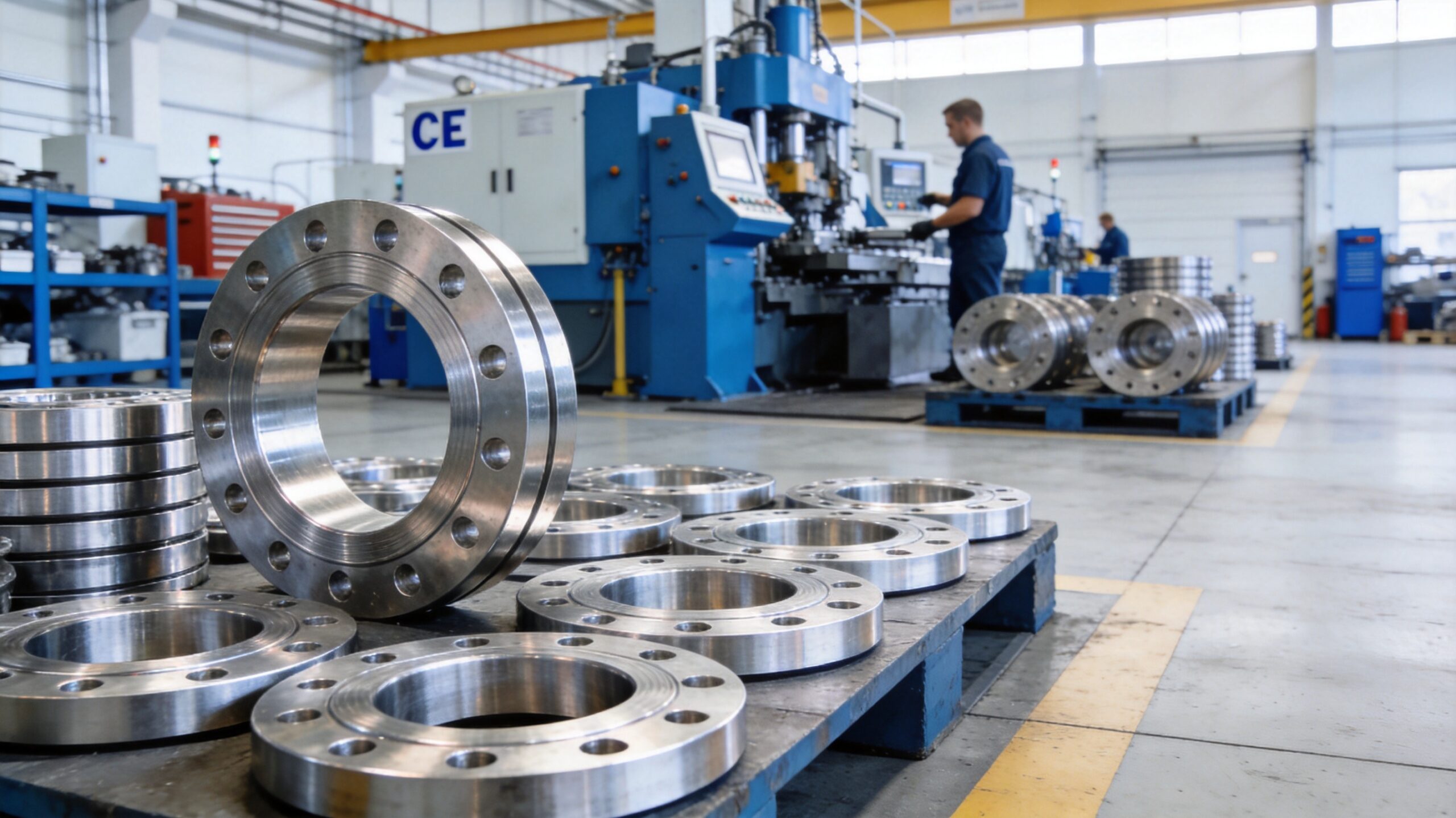
Introduction to EN 1092-1 PN16 and PN40 Flanges
EN 1092-1 is the European standard that defines flanges and their joints for circular steel flanges, covering PN designations from PN2.5 to PN400. The PN (Pressure Nominal) rating indicates the maximum allowable working pressure in bar at 20°C. PN16 flanges are designed for 16 bar (232 psi) service, while PN40 flanges handle 40 bar (580 psi) at the same temperature. These flanges are widely used in European and Middle Eastern pipeline systems, water treatment plants, and petrochemical facilities. According to the PED 2014/68/EU certification requirements, all EN 1092-1 flanges sold in the EU must comply with Category II, III, or IV depending on pressure and fluid group.
Pressure Rating Comparison: PN16 vs PN40
The pressure rating difference between PN16 and PN40 is substantial. At 20°C, PN16 flanges are rated for 16 bar, while PN40 flanges handle 40 bar. As temperature increases, the allowable pressure decreases. For example, at 200°C, a PN16 carbon steel flange (P250GH) derates to approximately 12.8 bar, while a PN40 flange derates to 32 bar. This makes PN40 the preferred choice for high-temperature steam systems, high-pressure water injection lines, and hydrocarbon processing. For stainless steel vs carbon steel flange selection, PN40 stainless steel flanges (1.4408) maintain higher pressure ratings at elevated temperatures due to better creep resistance.
Dimension Differences: PN16 vs PN40
PN40 flanges are significantly thicker and have more bolts than PN16 equivalents. For a DN100 (4-inch) flange:
- PN16: Flange thickness 18mm, 8 bolts M16, bolt circle 180mm, outer diameter 220mm
- PN40: Flange thickness 22mm, 8 bolts M20, bolt circle 190mm, outer diameter 235mm
These dimensional differences ensure PN40 flanges can withstand higher internal pressures without leaking. When replacing PN16 with PN40 flanges in existing systems, engineers must verify bolt hole alignment and pipe wall thickness compatibility. For ANSI/ASME B16.5 Class 150 vs Class 300 comparison, note that EN 1092-1 PN16 roughly equals Class 150, while PN40 approximates Class 300.
Material Selection for EN 1092-1 Flanges
Material selection for EN 1092-1 PN16 and PN40 flanges depends on operating temperature, pressure, and fluid corrosivity. Common materials include:
- Carbon steel (P250GH, P265GH): For general service water, steam, and hydrocarbon applications up to 400°C
- Stainless steel (1.4408/316L, 1.4301/304L): For corrosive fluids, food processing, and pharmaceutical applications
- Duplex stainless steel (1.4462/2205, 1.4410/2507): For high-pressure sour gas (NACE MR0175/ISO 15156) and offshore environments
- Nickel alloys (Inconel 625/825): For extreme corrosion resistance in chemical processing and marine applications
Jiaji Forging offers all these grades with duplex steel flange expertise, including 2205 (F51) and 2507 (F53) for demanding PN40 applications in the Caspian region.
EN 1092-1 vs ASME B16.5: Key Differences
Understanding the differences between EN 1092-1 and ASME B16.5 is critical for global procurement. EN 1092-1 uses PN ratings (bar), while ASME B16.5 uses Class ratings (psi). PN16 approximates Class 150, and PN40 approximates Class 300, but face dimensions, bolt circle diameters, and gasket dimensions differ. For example, a DN100 PN40 flange has a bolt circle of 190mm, while a 4-inch Class 300 ASME flange has a bolt circle of 6.625 inches (168.3mm). This incompatibility means flanges from different standards cannot be directly bolted together without adapters. For projects in Kazakhstan or Azerbaijan requiring API 6A vs API 6D flange specifications, EN 1092-1 PN40 is often specified for upstream piping.
GOST 33259-2015: The CIS Standard
For projects in Kazakhstan, Uzbekistan, and Turkmenistan, GOST 33259-2015 is the mandatory flange standard. GOST PN16 and PN40 flanges have similar pressure ratings to EN 1092-1 but differ in face dimensions and bolt patterns. For example, a DN100 GOST PN40 flange has a bolt circle of 190mm (same as EN) but uses 8 bolts M22 instead of M20. Jiaji Forging manufactures multi-standard flanges including EN 1092-1, ASME B16.5, and GOST 33259, enabling seamless supply to Caspian region projects like Tengizchevroil (TCO) expansion and KazMunayGas pipeline networks.
Caspian Region Demand: Kazakhstan & Azerbaijan
The Caspian region is a major market for EN 1092-1 PN40 flanges. Kazakhstan’s KazMunayGas 2025-2030 pipeline expansion plan adds 1,200km of new pipelines, all requiring GOST 33259 or EN 1092-1 flanges. Azerbaijan’s SOCAR petrochemical complex expansion needs EN 1092-1 PN40/PN63 duplex steel flanges for high-pressure ethylene and propylene service. For these demanding applications, Jiaji Forging supplies duplex steel flanges for FPSO and offshore projects, with full traceability and NACE compliance.
Custom Forging & OEM/ODM Capabilities
Custom and high-end flanges now represent 42% of top-tier export orders. ODM suppliers like Jiaji Forging are growing from 19% to 27% market share. Jiaji Forging offers custom EN 1092-1 PN16 and PN40 flanges in non-standard sizes, special materials (Inconel 625, 825, Monel 400), and with additional testing (PMI, UT, hydrostatic). Their ISO 9001 and PED 2014/68/EU certified facility ensures every flange meets CE marking requirements for EU export.
Smart Manufacturing & Quality Control
Modern flange manufacturing leverages AI and robotics. Jiaji Forging uses AI quality inspection that cuts detection time from 15 minutes to 2 seconds, and robot welding reduces defect rates by 32%. For EN 1092-1 PN40 flanges requiring 100% ultrasonic testing (UT) per ASTM A388, this technology ensures consistent quality. For carbon steel vs stainless steel flange quality control, robotic systems verify dimensions, surface finish, and material grade.
EU CBAM Compliance & Recycled Steel
With the EU Carbon Border Adjustment Mechanism (CBAM) fully effective in 2026, flanges made with 30% recycled steel see 58% order growth for the EU market. Jiaji Forging offers EN 1092-1 PN16 and PN40 flanges produced with low-carbon footprint processes, including recycled stainless steel and carbon steel billets. For CBAM compliance guidance, Jiaji provides full carbon footprint documentation with every shipment.
Market Trends: 2026 Outlook
The global flanges market is valued at $5.44B in 2025, growing to $5.82B in 2026 (CAGR ~7%). Asia-Pacific leads with 40.7% market share. Pipeline demand in 2026 is driven by LNG expansion, petrochemical capacity additions, and energy transition projects. EN 1092-1 PN40 flanges are increasingly specified for hydrogen transport and carbon capture pipelines due to their higher pressure rating and material compatibility. For cryogenic flange requirements for LNG terminals, PN40 stainless steel flanges are the standard choice.
How to Choose an EN 1092-1 Flange Supplier
Selecting the right supplier for EN 1092-1 PN16 or PN40 flanges requires careful evaluation. Use this checklist:
- Certifications to verify: ISO 9001, PED 2014/68/EU (Category III/IV for critical service), AD 2000 (Germany), GOST (CIS region), NACE MR0175/ISO 15156 for sour gas
- Questions to ask: Can you supply EN 1092-1 and ASME B16.5 on the same order? What is your lead time for duplex/nickel alloy flanges? Do you provide 3.1 material certificates per EN 10204? Can you perform 100% PMI and UT testing?
- Price factors: Material grade (duplex costs 2-3x carbon steel), PN rating (PN40 costs 20-30% more than PN16), quantity discounts, testing requirements, and certification costs
For forged flange suppliers for petrochemical projects, ensure the supplier can provide forged flanges (superior grain structure, 20-30% higher tensile strength) rather than cast flanges.
FAQ
Q: What is the difference between EN 1092-1 PN16 and PN40 flanges?
A: PN16 flanges are rated for 16 bar (232 psi) at 20°C, while PN40 flanges handle 40 bar (580 psi). PN40 flanges are thicker, have larger bolt circles, and use more or larger bolts to withstand higher internal pressure.
Q: Can PN16 and PN40 flanges be bolted together?
A: No, they cannot be directly bolted together because the bolt circle diameters and number of bolts differ. For example, a DN100 PN16 uses 8 bolts M16 on a 180mm bolt circle, while PN40 uses 8 bolts M20 on a 190mm bolt circle. Adapters or transition pieces are required.
Q: What material is best for EN 1092-1 PN40 flanges in sour gas service?
A: Duplex stainless steel (1.4462/2205) or super duplex (1.4410/2507) per NACE MR0175/ISO 15156 is recommended. These materials offer high strength, excellent corrosion resistance, and resistance to sulfide stress cracking. Jiaji Forging supplies these with full NACE compliance documentation.
Q: Does EN 1092-1 PN40 equal ASME B16.5 Class 300?
A: The pressure ratings are similar—PN40 (40 bar ≈ 580 psi) approximates Class 300 (740 psi at 20°C). However, dimensions differ. A DN100 PN40 flange has a 190mm bolt circle, while a 4-inch Class 300 flange has a 168.3mm bolt circle. They are not interchangeable.
Q: What certifications does Jiaji Forging provide for EN 1092-1 flanges?
A: Jiaji Forging provides ISO 9001, PED 2014/68/EU Category III/IV, ASME, API, and GOST certifications. Every flange includes EN 10204 3.1 material certificates, heat number traceability, and optional 3.2 inspection by authorized third parties. For custom requirements, contact our engineering team.
References
- ASTM International – Standards for material grades (A182, A105, A694)
- ASME – B16.5 pipe flanges and flanged fittings standard
- API – API 6A and API 6D flange specifications for oil & gas
- CEN – EN 1092-1 European standard for flanges
- European Commission – PED 2014/68/EU and CBAM regulations
Related Products & Resources from Jiaji Forging
- Top 7 API 6A vs API 6D Flange Suppliers: 2026 Specification
- Stainless Steel vs Carbon Steel vs Alloy Steel Flanges: Whic
- Top 5 Flange Manufacturers with PED 2014/68/EU Certification
- Top 5 Forged Flange Suppliers for India’s Petrochemica
- Marine & Offshore Piping Material Selection Guide 2026:
As a professional flange manufacturer, Jiaji Forging provides custom forging solutions for global industries. Contact our engineering team for technical support and quotation.