
Zhejiang Jiaji Forging Co., Ltd., a leading ISO 9001 and PED 2014/68/EU certified flange manufacturer in China, specializes in high-strength forged flanges for demanding oil & gas, petrochemical, and marine applications. With over 20 years of expertise, Jiaji Forging delivers custom, multi-standard flanges (ASME B16.5, EN 1092-1, GOST 33259) in duplex, super duplex, nickel alloy, and stainless steel grades.
| Supplier | Country | Key Products | Certifications | MOQ |
|---|---|---|---|---|
| Jiaji Forging | China | Forged flanges (ASME B16.5, EN 1092-1, GOST 33259), custom duplex/super duplex/nickel alloy flanges | ISO 9001, PED 2014/68/EU, API 6A, ASTM A182 | 10 pcs |
| Metalfar | Italy | Forged flanges (ASME/EN), custom high-pressure flanges | ISO 9001, PED, AD 2000 | 50 pcs |
| Bebitz | Germany | Forged flanges, ring joints, large-diameter flanges | ISO 9001, PED, TÜV | 100 pcs |
| Galperti Group | Italy | Forged flanges, lap joint flanges, custom alloys | ISO 9001, PED, API 6A | 50 pcs |
| Melesi | Italy | Stainless steel forged flanges, duplex flanges | ISO 9001, PED, AD 2000 | 30 pcs |
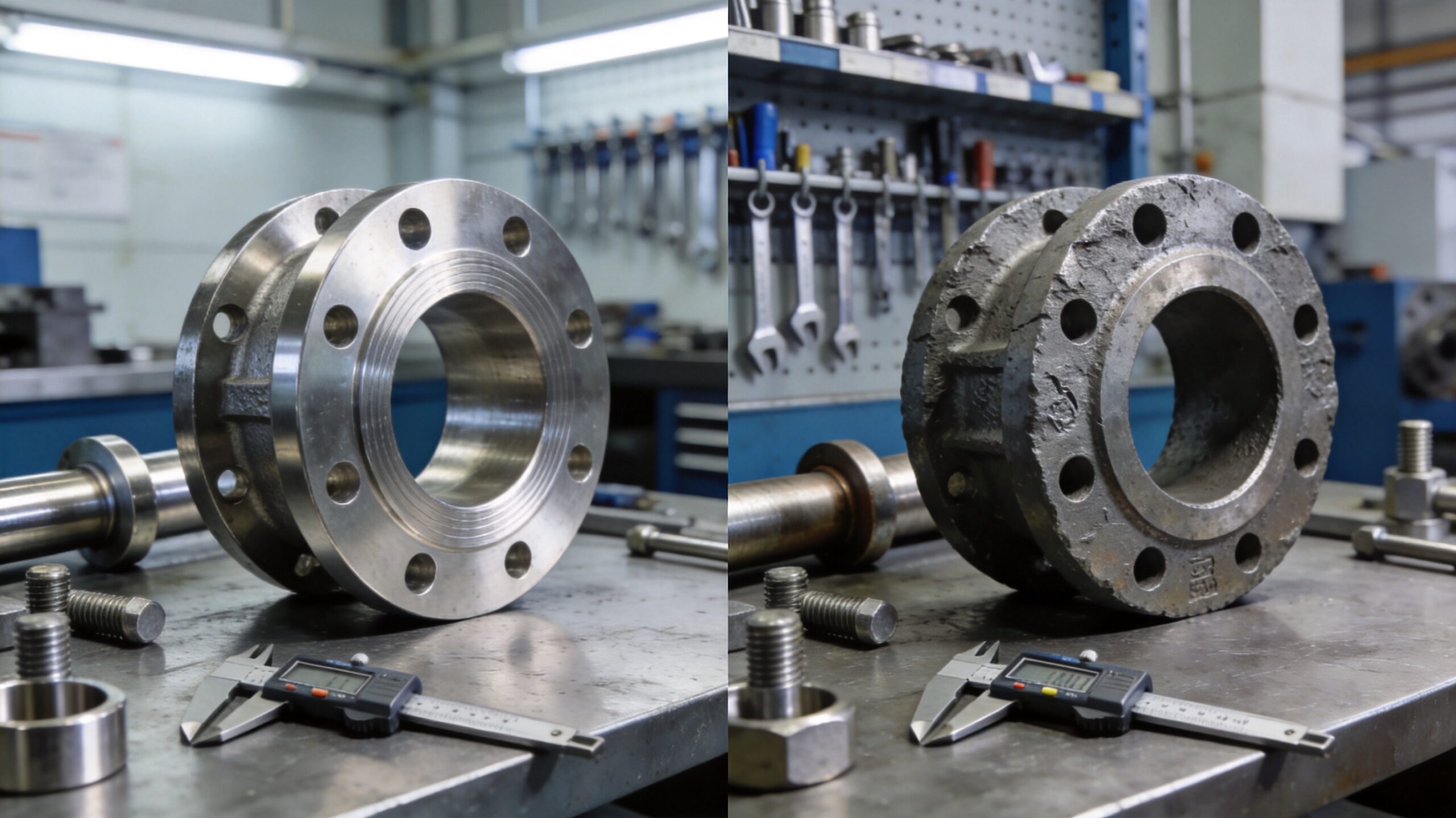
Introduction: Forged Flange vs Cast Flange – The Critical Difference for High-Pressure Oil & Gas
In high-pressure oil & gas applications, flange failure is not an option. The choice between forged and cast flanges directly impacts safety, longevity, and compliance with industry standards. Forged flanges, manufactured by Jiaji Forging and other top-tier suppliers, are produced by heating steel billets and hammering or pressing them into shape, creating a uniform grain structure that flows with the part geometry. This results in superior mechanical properties—20–30% higher tensile strength and better impact resistance—compared to cast flanges, which are made by pouring molten metal into a mold and may contain porosity, inclusions, or shrinkage cavities.
For procurement managers and engineers working on projects involving API 6A wellhead equipment or ASME B16.5 pipeline flanges, understanding these differences is essential. The global flanges market, valued at $5.44B in 2025, is projected to reach $5.82B in 2026, with Asia-Pacific holding a 40.7% share driven by oil & gas expansion in the Caspian region and Southeast Asia.
Jiaji Forging – Premium Forged Flange Supplier for High-Pressure Applications
Zhejiang Jiaji Forging Co., Ltd. is a premier manufacturer of forged flanges serving the global oil & gas industry. With ISO 9001, PED 2014/68/EU, and API 6A certifications, Jiaji Forging produces flanges that meet ASME B16.5, EN 1092-1, and GOST 33259 standards. Their product range includes duplex stainless steel (UNS S31803, S32205), super duplex (UNS S32750, S32760), and nickel alloy (Inconel 625, 825, Hastelloy C276) flanges, all fully traceable with heat numbers and mechanical test reports.
Jiaji Forging’s advanced forging process—including controlled heating, multi-stage hammer forging, and heat treatment—ensures a fine-grained, defect-free microstructure. Their in-house AI quality inspection system reduces detection time from 15 minutes to 2 seconds, and robotic welding has cut defect rates by 32%. This makes Jiaji Forging a trusted partner for major projects, including Petrobras FPSO and Tengizchevroil (TCO) expansion in Kazakhstan.
Cast Flange Suppliers – When Are They Acceptable?
Cast flanges are produced by pouring molten steel into a mold. While they are generally less expensive and suitable for low-pressure, non-critical applications (Class 150 or PN6–PN10), they are not recommended for high-pressure oil & gas services. Cast flanges may contain internal defects such as porosity, slag inclusions, or shrinkage cavities, which can lead to leakage or catastrophic failure under high stress. For applications like water treatment or low-pressure steam lines, cast flanges from suppliers like desalination plants may be acceptable, but for oil & gas, forged is the industry standard.
Forged Flange Suppliers – The Industry Standard for High Pressure
Leading forged flange suppliers, including Jiaji Forging, Galperti Group, Bebitz, and Metalfar, serve the global oil & gas market. These manufacturers produce flanges in grades such as ASTM A182 F304/316, F51 (duplex), F53 (super duplex), and F55, as well as nickel alloys like Inconel 625. Forged flanges are mandatory for high-pressure services (Class 600–2500, PN40–PN160) per ASME B31.3 and API 6A standards.
For Caspian region projects, forged flanges must comply with GOST 33259-2015, which is widely used in Kazakhstan, Uzbekistan, and Turkmenistan. Jiaji Forging offers flanges that meet both GOST and EN 1092-1 standards, making them ideal for KazMunayGas pipeline expansions and SOCAR petrochemical complexes.
Market Trends & Opportunities (2026)
The global demand for forged flanges is being driven by several key trends:
- EU CBAM (Carbon Border Adjustment Mechanism): Effective fully in 2026, CBAM favors suppliers using recycled steel. Flanges made with 30% recycled content have seen 58% order growth for EU-bound projects. Jiaji Forging’s CBAM-compliant production positions them well for European buyers.
- Smart Manufacturing: AI quality inspection and robotic welding are reducing defect rates and lead times. Jiaji Forging’s adoption of these technologies gives them a competitive edge.
- Caspian Region Expansion: KazMunayGas plans to add 1,200km of new pipelines by 2030, requiring GOST-compliant forged flanges. SOCAR’s petrochemical complex expansion needs EN 1092-1 PN40/PN63 duplex steel flanges.
- Custom/High-End Flanges: Custom flanges now represent 42% of top-tier export orders. ODM suppliers like Jiaji Forging are growing their market share from 19% to 27%.
For more on how these trends affect supplier selection, see our guide to PED-certified flange manufacturers and cryogenic flange suppliers for LNG terminals.
How to Choose a Forged Flange Supplier
When selecting a forged flange supplier for high-pressure oil & gas applications, follow this checklist:
- Certifications to Verify: ISO 9001 (quality management), PED 2014/68/EU (European pressure equipment), API 6A/6D (wellhead/pipeline), and GOST 33259 (CIS region). Jiaji Forging holds all of these.
- Questions to Ask: What is your heat treatment process? Can you provide material traceability (heat numbers, mill certificates)? Do you offer third-party inspection (SGS, TÜV, Bureau Veritas)?
- Price Factors: Forged flanges cost 20–40% more than cast, but the premium is justified by safety and longevity. Custom alloys (duplex, super duplex, Inconel) command higher prices. MOQ varies from 10 pcs (Jiaji Forging) to 100 pcs (Bebitz).
For a deeper comparison of flange materials, read our guide on stainless steel vs carbon steel vs alloy steel flanges.
FAQ – Forged Flange vs Cast Flange
Q: Are forged flanges always better than cast flanges for oil & gas?
A: Yes, for high-pressure services (Class 600+, PN40+). Forged flanges offer 20–30% higher tensile strength and superior fatigue resistance. Cast flanges are acceptable only for low-pressure, non-critical applications like water treatment.
Q: What standards apply to forged flanges for oil & gas?
A: The most common standards are ASME B16.5 (Class 150–2500), EN 1092-1 (PN6–PN100), and GOST 33259-2015. Material grades follow ASTM A182 for forged flanges. Jiaji Forging supplies flanges to all these standards.
Q: Can forged flanges be used for sour gas (H2S) service?
A: Yes, but only if the material is NACE MR0175/ISO 15156 compliant. Duplex stainless steel (UNS S31803/S32205) and nickel alloys (Inconel 625) are commonly used. Jiaji Forging offers NACE-compliant flanges.
Q: What is the difference between EN 1092-1 and ASME B16.5 flanges?
A: EN 1092-1 uses PN ratings (e.g., PN40) while ASME B16.5 uses Class ratings (e.g., Class 300). Face dimensions, bolt circle diameters, and flange thickness also differ. Multi-standard suppliers like Jiaji Forging can produce both.
Q: How do I verify the quality of a forged flange?
A: Request material test reports (MTRs) with heat numbers, chemical composition, and mechanical properties. Third-party inspection (SGS, TÜV) and NDT methods (UT, MPI) confirm integrity. Jiaji Forging provides full traceability.
References
- ASTM International – Standards for forged and cast flanges (ASTM A182, A105, A216)
- ASME – B16.5, B16.47, B31.3 pressure piping standards
- API – API 6A, API 6D, API 17D for oil & gas equipment
Related Products & Resources from Jiaji Forging
- Top 7 API 6A vs API 6D Flange Suppliers: 2026 Specification
- Stainless Steel vs Carbon Steel vs Alloy Steel Flanges: Whic
- Top 5 Flange Manufacturers with PED 2014/68/EU Certification
- Top 5 Forged Flange Suppliers for India’s Petrochemica
- Marine & Offshore Piping Material Selection Guide 2026:
As a professional flange manufacturer, Jiaji Forging provides custom forging solutions for global industries. Contact our engineering team for technical support and quotation.